
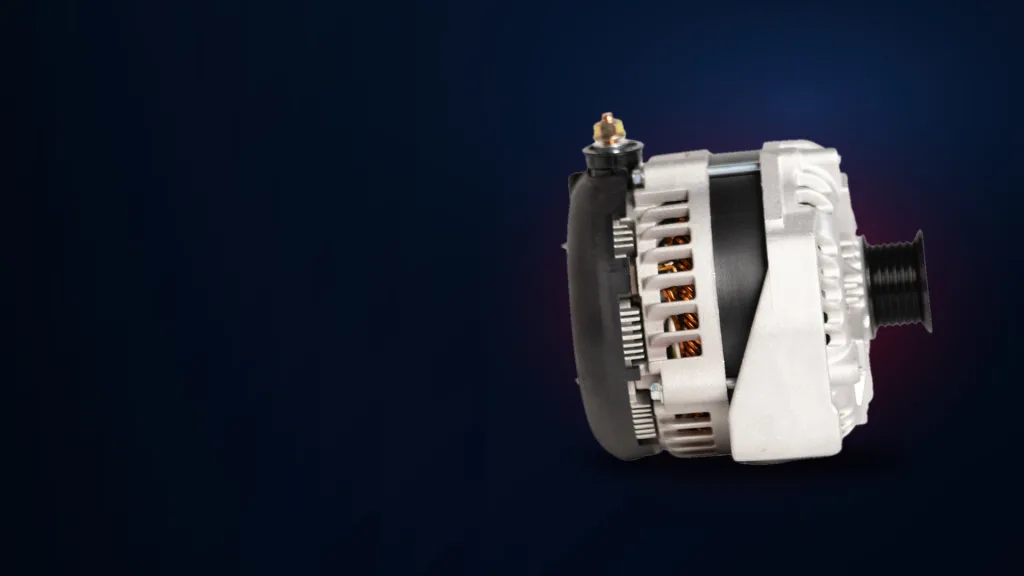
Every bass build hits the same wall eventually: the lights dim on every note, voltage drops into the 12s, and the amp starts protecting. That isn’t a subwoofer problem. It’s a charging problem. Your amplifier can only make power from the current your electrical system can feed it, and on most vehicles the stock alternator ran out of room a long time ago.
Here’s how to figure out how many alternator amps your system actually needs, without guessing.
The simple math: watts to amps
Amplifiers turn electrical current into audio power, and they aren’t 100% efficient. A good class D bass amp runs roughly 75 to 85% efficient at full tilt. To estimate how much current an amp pulls at full rated power:
Amps = RMS watts ÷ (charging voltage × efficiency)
Using 14.4 volts and 80% efficiency, that works out to about RMS watts ÷ 11.5.
| Amplifier RMS | Current at full power (approx.) |
|---|---|
| 1,000 W | ~87 A |
| 2,000 W | ~174 A |
| 3,000 W | ~260 A |
| 5,000 W | ~435 A |
| 10,000 W | ~870 A |
Those are full-power, continuous numbers. Music isn’t a continuous sine wave, so the average draw on a daily system is a lot lower. But the peaks are real, and the peaks are what pull your voltage down.
Don’t forget the car itself
Your vehicle needs current before the stereo plays a single note. Fuel pump, ignition, fans, lights, HVAC blower, heated seats and the computers can easily use 50 to 100 amps on a modern car or truck at night with the A/C on. A typical factory alternator is rated somewhere around 105 to 180 amps, and that rating is at high RPM, not idle. Add it up and most stock alternators have very little left over for an amplifier.
A practical rule for picking an alternator
- Daily system up to about 2,000 W RMS: a quality 250 amp high output alternator plus the Big 3 upgrade usually keeps voltage healthy.
- 2,000 to 4,000 W RMS: look at 320 to 400 amp units, plus extra battery storage in the back.
- 4,000 W and up: plan on a 370 to 400 amp alternator, serious battery storage, and possibly a second alternator on a bracket kit.
The goal isn’t to make the alternator cover every peak by itself. The goal is to keep voltage high and refill your batteries between notes. Alternator and batteries work as a team. More on that in alternator vs more batteries.
Signs you’ve outgrown your alternator
- Headlights or dash lights dim on bass hits
- Voltage drops below about 13 volts while playing
- Your amp goes into protect or gets hot fast at volume
- Batteries are never fully charged after a session
- Your stock alternator keeps failing (they cook when you run them flat out)
Why we carry JS Alternators
We build subwoofers that are meant to be pushed, and they only sound right with clean voltage behind them. JS Alternators builds high output alternators from 170 to 400 amps in Anderson, South Carolina. They’re direct-fit for thousands of cars, trucks and Jeeps, bench tested before they ship, and they come with lifetime labor and one year parts warranty. They ship with an overdrive pulley to spin the alternator faster at idle, which is where most stock units fall flat.
Find yours: open the EM Audio alternator finder, pick your year, make, model and engine, and you’ll see every JS unit built for your vehicle, priced the same as JS and shipped free to the lower 48. Not sure it fits? Send us your vehicle and a photo of your current alternator through the fit check form and we’ll confirm it before you order.
Quick FAQ
Is a bigger alternator bad for my car?
No. An alternator only supplies the current the system asks for. A 320 amp unit on a quiet car makes about the same current as a stock one. The extra is there when the amp asks for it.
Do I still need batteries?
For anything past a modest daily setup, yes. Batteries handle the instant peaks and the alternator refills them.
Do I need the Big 3?
Yes. JS requires a Big 3 wiring upgrade with every high output alternator. Factory wire can’t carry the extra current without voltage drop and heat.